

On the two Marys
Visions of motherhood, care, and survival

I have been thinking about the character of Mary from Il Vangelo Secondo Matteo (The Gospel According to St. Matthew), Pasolini’s 1964 film about the life of Christ. Pasolini's Mary is small and sensual with soulful eyes and a look that will haunt you forever. She is so young. It's easy to forget that the biggest symbol of maternity in the Western world was herself no more than a child. Insofar as we know anything about the historical person Mary of Nazareth, we know that. She was a young girl, only just of child bearing age. Margherita Caruso, the actress who played the young Mary, was 14 when the film came out.
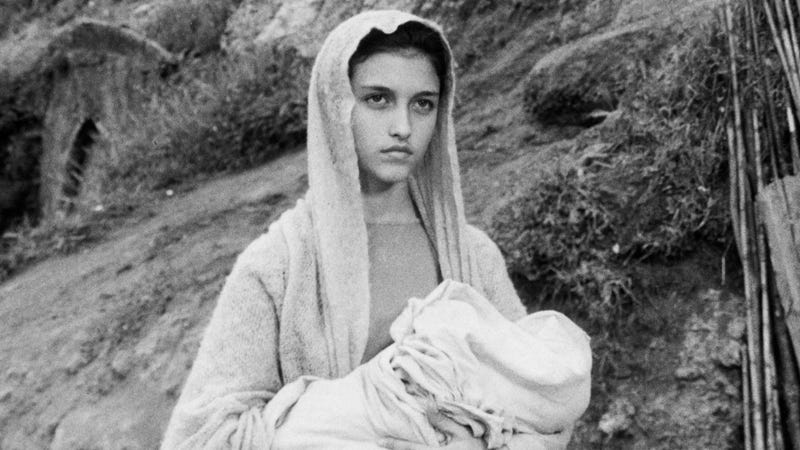
In every scene in which Caruso appears at the start of the film, she is either heavily pregnant or holding a child. In our visual imaginary, we cannot uncouple Mary from the visible, tangible, bodily markers of gestation or motherhood.
Contrast this to the visual iconography of another Biblical Mary: the Mary known as the Magdalene. The Magdalene is childless. In visual art she is most often depicted alone, in a state of ‘penitence’. What is penitence? In Catholic doctrine, penitence is one of the seven sacraments, a means of obtaining the mercy of God by acknowledging and confessing one’s sins. (I remember my first confession as a fearsome and momentous occasion, the much-awaited endpoint of our catechism course, when we would finally be allowed to traverse the stairs to meet the priest for a one to one audience. I remember practising what I would say in my head, over and over, praying I wouldn't fumble with each step up to his office. I remember his look when he said ‘is that all child?’ as I blurted out my short list of transgressions.)
You repent or say sorry for the sins you've committed, taking care to show how genuine your remorse is, and in return you are told what to do in exchange for being absolved of them. Most often it's a set number of Hail Mary's, that short prayer addressed to a mother. Ave Maria, piena di grazia. Full of grace. How seamlessly and naturally that sing song first line is imprinted in every Italian child's mind.
My grandmother's name is composed of the two ends of that first line, like a parenthesis. Maria Grazia.In her life and in her suffering, my grandmother is more of a Magdalene than a Mary. We were born on the same day in late summer, 64 years apart. I inherited her name, inserted between my first and last. But instead of ‘Maria Grazia’ my mother opted for her nickname, Graziella. Little grace. A name elided, enacting its own kind of Noli me tangere, bearing no more than a silent echo of Maria. In photographs of her as a young woman my grandmother is is not a million miles from Pasolini's young Maria, but more aloof, less shrouded in the immediacy of youth.
The Magdalene is penitent because she is a sinner—a sinner of the flesh. But this version of the Magdalene was in part a fabrication. Pope Gregory I was the first to interpret the Magdalene as a prostitute, eliding Mary Magdalene and an unnamed woman who, in Luke’s Gospel, is described as entering a house Jesus is visiting and weeping, her tears falling on Jesus’s bare feet, which she begins to wash with her hair and anoint with a jar of perfume. Luke describes this woman as ‘sinful’. In John’s Gospel, however, she is Mary of Bethany, sister of Martha and Lazarus. Since Gregory, the two Marys became one.
Who was the Magdalene before she was made into the archetypal female sinner, the Lustful Woman, and then the reformed whore? Mary of Magdala: maybe just a woman who wanted to feel, touch, sense, taste, experience. Or someone who understood the (market) value of female sensuality, fated to inhabit that liminal space built by society’s double consciousness, at once repulsed and obsessed with female flesh. Or perhaps, or probably, neither of these things, just a woman who loved a man who moved her but could never love her back.
When the Magdalene is not alone, she is represented during or just after her discovery of Christ's empty tomb, when Jesus has just risen from the dead. Often she is reaching out towards him. In the typical gesture of the “Noli me tangere” (lit. Do not touch me), Jesus shirks her hand. She cannot bring her body in contact with his because he is no longer of the earth, and not yet one with God. Mary the Virgin is instead never not touching—holding, cradling, coddling, breastfeeding—whether it's the infant Jesus or his dead body released from the Cross.
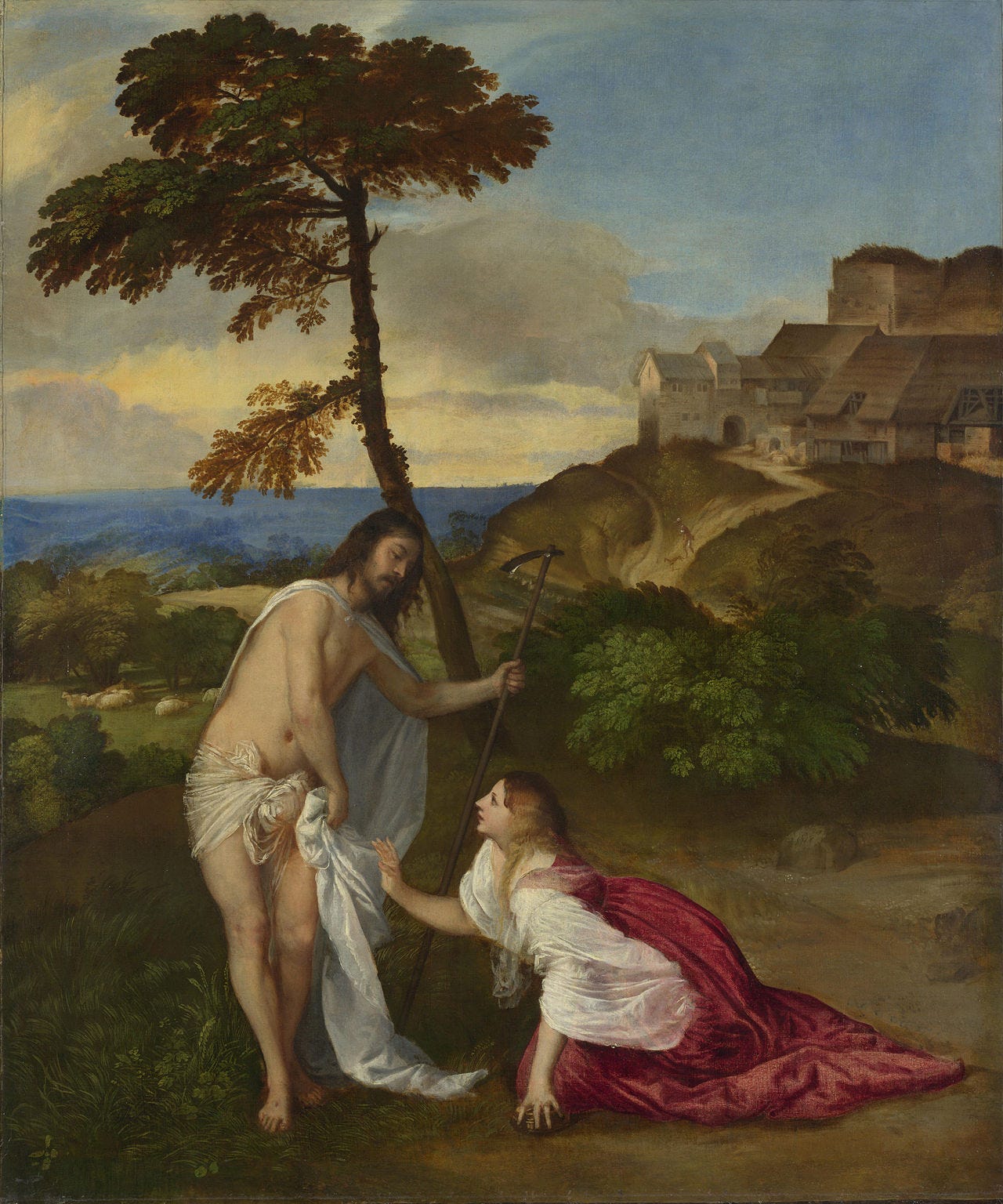
The Magdalene reaches out, wants to grasp what she cannot, what is not hers to touch. She is in this sense always excessive. Contrast this with the tradition of the Stabat Mater, those Catholic poems and hymns praising the Virgin that often begin with a description of her standing, resolute, at the foot of the cross. Stabat=she stood. Not leaned, reached, grasped, threw herself. Although all that might happen in the poems, the emphasis is on stillness, fixedness. The Magdalene cannot stay still. She wants to transcend: the boundaries between bodies, between earthly and heavenly, between virtue and sin. Note also how the landscape around her in Titian’s painting above is bare (by contrast to the lush verdant landscape around Jesus), suggestive not only of the Magdalene’s own barrenness, but also indicating that whatever she touches turns dry, arid, infertile.
In her suffering, as in the art that represents her, the Magdalene is radically alone. It is this I think that makes her, paradoxically, the perfect symbol for motherhood. This is not the loneliness that comes from being not cared for or not understood, but something more radical: the kind of loneliness that comes from loving someone (or something) that cannot love you back in the same way. I see in the Magdalene’s loneliness a refraction of the formula uttered by Jesus on the Cross: ‘Eli, Eli, lama sabachthani?’ or, ‘My God, my God, why hast thou forsaken me?’, although the lack she is mourning is earthly, sensual, the touch of a man who knew her, who saw her, and saw through the constructions built around her persona. If the Magdalene communicates through touch, the Noli me tangere records the impossibility of reciprocal communication. Jesus ascends and the Magdalene is left behind, clutching at air. (The imperative noli in Latin comes from the verb nolle/non volle=not to want. Jesus is literally saying to Mary, do not wish to touch me or perhaps, do not be desirous of my touch.)
Earlier this year I saw two paintings by Caravaggio whose subjects are the two Marys. In the first, Mary the Virgin is depicted cradling the baby Jesus next to an angel and an aging Joseph. The presence of the angel reminds us that this is the holy family, and the atmosphere is blessed, divine. Mary is in a pose of graceful slumber, soft and relaxed.
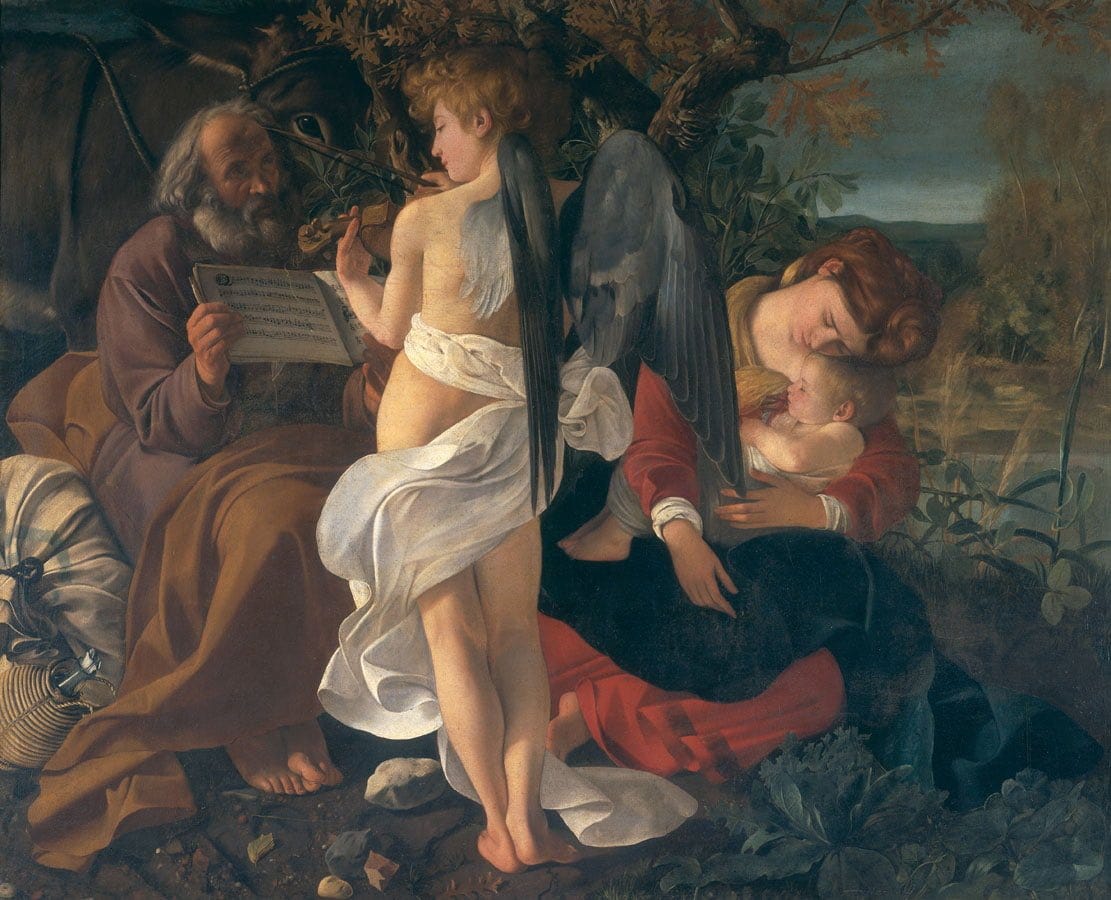
In the painting of the Magdalene she is instead, predictably and inexorably, alone. Note how Caravaggio has used an almost identical pose for the two Marys (scholars believe the two figures were based on the same live model). But while the Virgin’s gaze is soft and tender, as if she has just fallen asleep in a blissful embrace with her infant child, the Magdalen furrows her brow and cradles empty space, an absence. (As I write this I’m clutching for a word in English that can capture the space circumscribed by the Magdalene’s arms. The word I am looking for is an equivalent of grembo, an Italian word denoting the bit of external flesh corresponding to the womb. An online dictionary tells me that the English translation is ‘lap’—but this lacks the connotations of warmth and motherliness, of the comfort associated with that bit of female anatomy.)
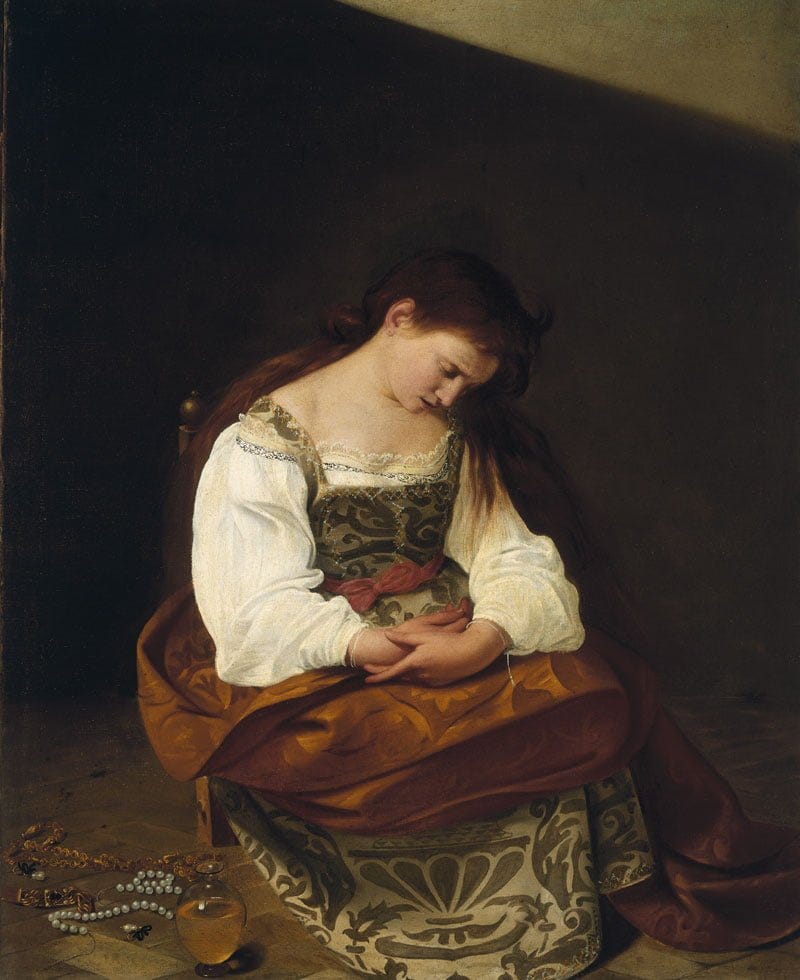
The deep blackness surrounding her is reminiscent of the barren landscape in Titian’s Noli me tangere. Aside from a few items denoting earthly pleasures—pearls and a vessel holding wine—Mary is engulfed by absence. (See instead how in the first painting Mary and the other figures are bathed in a soft light, and all the accoutrements of the painting are heavenly, not earthly.)
What does it mean to care from a place of radical loneliness, that precludes the possibility of reciprocity? We might think that a healthy response would be to accept the lack and to move beyond it, to try and sublimate it somehow. But if we learn anything from the Magdalene, we learn the power of non-acceptance. The Magdalene is shirked, abandoned, and yet, she clutches, she grasps, she wants, she yearns, she does not stop the dance of impossible love. This might just be a version of Keats’s concept of negative capability, or the idea that we could learn to accept unknowing and undecidability, that we could live in the absence left behind by questions that do not have answers, (“Why have you forsaken me?”) and in doing so discover a form of radical possibility. Does this not capture the love of a mother? A love based on uncertainty, non-reciprocity, asymmetry. Perhaps in this it is the archetypal kind of love.
As is well known, Pasolini originally intended to shoot The Gospel According to Matthew in Palestine. When he went for a site visit in 1963, he was put off by the extent of Israeli construction, modern buildings with garish fronts that spoke of burgeoning capitalist expansion and little of the projected purity of the Holy Land. Instead, he returned to Italy and toured Matera, that city of dwellings excavated in the rock, which by the 1960s had become a symbol of the divide between ‘new’ and ‘old’ Italy, between an industrialized, modernized, developed country, and the Italy of illiteracy and malaria, of local dialect and folklore, of the absence of state welfare or tutelage. Nowadays you can tour the old town and see inside some of the caves in a glamourised version of poverty tourism. The caves and the wider imaginary surrounding Matera no doubt captured Pasolini’s imagination for their representation of a different (no less fetishizing) kind of projected purity.
The extras in the film are played by Materan locals, in a continuation of Pasolini’s famous style of documentary film making, taking the camera to the people, those sections of society, uncorrupted by ‘culture’, that he saw as the as the antidote to the stifling mediocrity of the petit bourgeoisie. The Magdalene doesn’t feature in the film, but the older Virgin Mary is played by Pasolini’s own mother. There’s a continuity between those two decisions, that of having local amateur actors play the parts of extras in the imagined ‘purity’ of the landscape and context of Jesus’s coming of age and ministry, and of casting his mother as the mother of God: the Virgin after all is a space of pure projection, the EveryMother. What is missing in all of this is the particularity of the pathos that a figure like the Magdalene provides. Her suffering is both unique and universal, at once a radically personal and lonely encounter with the divine and a typical experience of asymmetrical love. Something of this is lost as the amateur actors rub shoulders with figures of personal significance as well as figures of the Italian literary establishment (a consequence of Pasolini’s penchant for having his friends cameo in his films. In one of the shots of The Gospel According to St. Matthew you can see a smiling Natalia Ginzburg). The result is a vision of (spiritual) love that feels too perfect, too close to the archetypal image of the love of the Madonna as all-encompassing (that full and comforting grembo, or lap).
Part of this feeling is surely elicited from the spectral presence of Palestine that underwrites the film, of what, or where, the film could have been. Scarcely a day has gone by over the last nine or so months in which I have not thought about expecting and neo-mothers in Gaza. If the love felt in early and expectant motherhood is one born of deep loneliness, what of the grief, and the impossibility of grief, that accompanies motherhood within the horror and terror of genocide? An abyss without name. I don’t know how to reconcile the ideas of motherhood I’ve tried to sketch here with the existence of this parallel reality. I don’t know how because it is impossible. It is beyond reason, beyond logic. How to mourn for a lost child, a lost mother, amidst a reality that persists in denying you that freedom? This is perhaps one of the greatest cruelties of the Western-backed Israeli war machine, where life is not just dispensable but becomes ungrievable. How easy then as witnesses from our relative comfort to collapse that space once more into a projection of oneness, blankness: an entire landscape into a mass nameless grave.
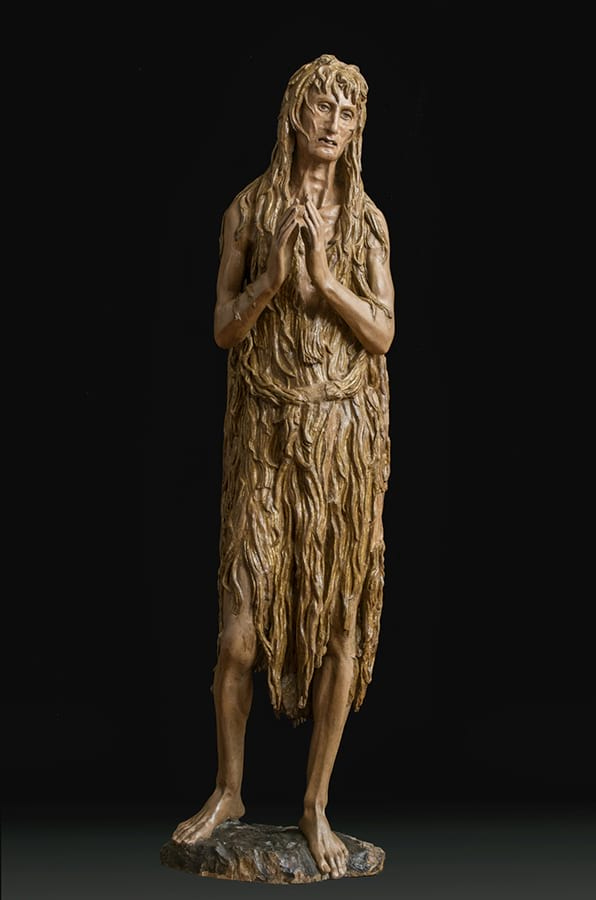
Perhaps the most honest portrayal of the Magdalene is Donatello’s haunting sculpted rendition. She is awkward and uncomely, her face gaunt, supremely unsexy. The role of her hair is central here, and exaggerated, almost reducing to absurdity its longstanding association with the Magdalene since her identity was (mistakenly?) taken for that of the woman who washed Jesus’s feet with her hair. Where in Renaissance paintings, versions of the Magdalene with beautiful, sensuous locks abound, Donatello instead chooses to makes the hair excessive, almost grotesque. It cascades down her shoulders and forms the essence of her tunic, and the belt clinching a non-existent waist. And yet there is a tenderness in this sculpture that is hard to pin down. It starts with her vacant gaze, lost somewhere in middle distance, caught between reflection and melancholy. The soft touch of her hands coming together in prayer, her right foot hovering over the pedestal, her body tilted ever so, as if she is deciding whether or not to move forward to greet an invisible stranger. This Magdalene is shrouded in absence, in privation (her gaunt cheeks, the wasted frame). The effect is, I suppose, to remind the onlooker of the extent of her penitence, her deep commitment to traversing and then renouncing her sin. But I see in this Magdalene a figure of maternal abandon. She proposes a model for confronting the impossibility of reciprocity and surviving it (not to resolve it), to build it into your continued existence. In an interview following the release of The Gospel Pasolini is asked whether he seeks consolation from the Bible. His answer is telling: he rejects the idea of consolation but says instead that the gospel ‘fills’, ‘integrates’, ‘regenerates’. The Magdalene, too, rejects consolation, is inconsolable. But what she offers instead is a powerful alternative: the possibility of living with the emptiness, of not ‘filling’ or ‘integrating’ but accepting absence as a part of oneself, as a part of love.