

2025 in Books

I have been thinking about the function of the list. The list as device and performance. But also the list as it lends itself so seamlessly to easily shareable and digestible online formats. I started writing on this platform to keep track of the books I read and some of my thoughts about them. I only this year discovered the ‘social’ aspect of the platform—by downloading the app I suddenly was made aware of the preponderance of the list among the dizzying quantity of the platform’s offerings—lists of places to see in X city, lists of books that will change your life, lists of ways to become a ‘real’ writer, lists of favourite jeans, best cashmere tops, fluffiest house slippers—and that a huge chunk of writing that appears on here is wedded to metrics of growth and reach, which also replicate the accretional logic of the list. The list is both compulsive and distracted. It is a great vehicle through which to sell people things.
Why do we make lists? As indexes of personality (or online persona). As a way to advertise a particular way of living that appears unique but replicates the compulsive structure of conformity. Endless repetition with minor variations.
Anyway, here is what I read in 2025.
I started the year with Sally Rooney’s Intermezzo, a Christmas present from N. with a sardonic dedication along the lines of ‘we love to hate…’. I don’t hate SR, in fact find most of her prose admirably compelling, and I entered Intermezzo in good faith. I wondered about the poorly executed phrasing in a lot of this, the stylistic gambles that didn’t pay off, and what it has to do with the liberties bestowed on a bookselling titan, who can afford to depart from their usual style, to take ‘risks’ (although the notion of what is classified as a risk in the publishing world is precisely the problem here) because people will buy the books regardless. It left me feeling a little down about the possibilities of mainstream fiction, not because the book was atrocious (it wasn’t) but because it seemed to embody a limited view of fiction’s horizons.
Also in January I read Mavis Gallant’s Green Water, Green Sky a novella about a mother-daughter American emigré duo, which, compared to the Rooney, felt fresh, brisk, while retaining a mystique, that impenetrability that is characteristic of the novella or short story done well. I followed it with incontrovertibly the best read of the year, Dostoevsky’s Crime and Punishment. It took me 32 years to read Dostoevsky (barring The Village of Stepanchikovo which I’d read for a class at university). Excuse me, but what the fuck! This book changed everything, including, for a while, the structure of my dreams.
I needed something distinct after the Dostoevsky, so I read Nicola Barker’s H(A)PPY, which was a truly sumptuous reading experience, a sensory immersion, and better even than The Employees as far as recent soft dystopian sci-fi I’ve read. I then read, or attempted to read, Danilo Kiš’s Encyclopedia of the Dead, a short story collection I’d bought maybe almost ten years ago on the recommendation of Svetlana Boym, whose class on exile had a strong impact on my reading. The central story was furiously good but I struggled through the rest of the book, whose cerebral mysticism seemed too remote from the mystical mundanity of the early months of parenthood. I chased it with Mundanity Literature king, Alejandro Zambra, and his The Private Life of Trees, a minuscule novella I swallowed during one of the baby’s naps. Soppy and wry and Zambra all over. In a bid to keep reading books I’d bought ages ago, usually in various Oxfam Bookstores, that had piled up over the years, I picked Penelope Lively’s memoir Ammonites and Leaping Fish. Too British and twee for my tastes, it probably would have helped to have read at least one of Lively’s novels (maybe this year), but its reflections on the arc of a life from the point of view of old age were a refreshing antidote to so much internet content by young people along the lines of ‘things you will regret when you’re 80’. Respectfully, you don’t know what the hell you’re talking about.
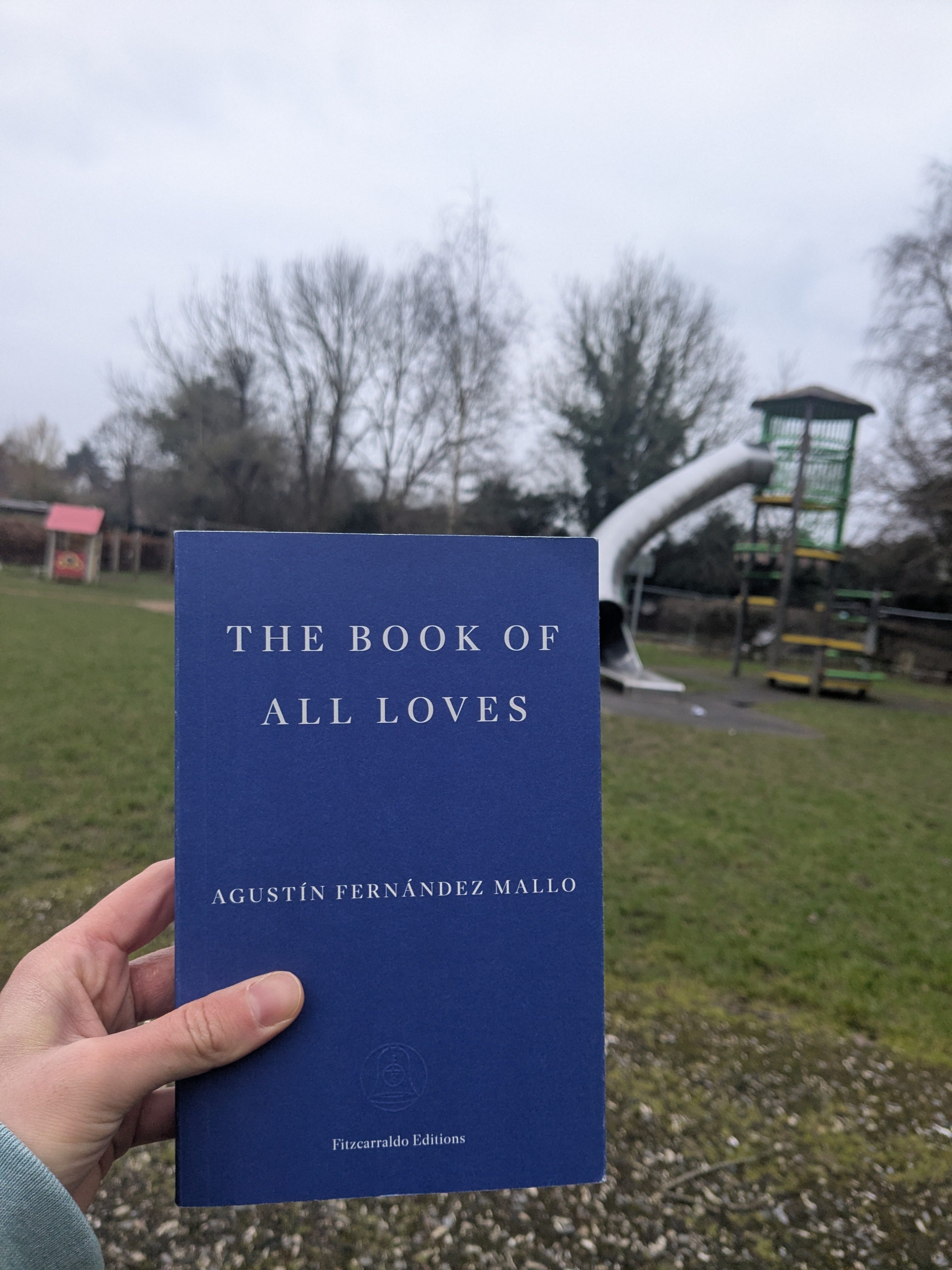
In mid-February I devoured most of Augustín Fernández Mallo’s The Book of All Loves in one freezing morning while pushing the baby round and round the local playground. Something about its lent itself to centrifugal movement. I’d never read any Mallo before and found it funny he was later mentioned among the practitioners of ‘Brodernism’ in that viral essay on the American fetishism of ‘difficult’ literature. The piece is good on the parochial logic of the anglophone book market but categories like this inevitably collapse upon probing—as someone who would almost definitely fall under the anti-brodernist camp, I love many of the writers listed in that piece: Krasznahorkai, Bernard, Levrero, Pynchon.
Next was another aging Oxfam Bookstore buy, Ann Patchett’s State of Wonder. This really did deserve to be called ‘atrocious’. It had been a while since I’d read something truly dreadful and I’d forgotten that this is its own kind of illuminating experience.
I hit refresh by turning to non-fiction. I read Vivian Gornick’s The Situation and the Story. Gornick is so good at distilling complicated, vague and quasi-mystical elements of experience into pearl-like sentences. You might not always agree, but the force of them shakes you into doing some thinking, becoming the sort of reader who actively dialogues with a text rather than passively absorbs it. Despite the wealth of alluring non-fiction discussed in the Gornick I went back to the novel. I started Hardy’s Tess of the d’Urbervilles for no other reason than a copy was at hand where I happened to be staying in March. I sailed through the first 150 or so pages but then hit a wall. I was expecting the character of Angel Clare to provide an interesting foil to Tess’s almost nauseating naivety but instead he was tiresome and patronising. I’ve been persevering in small stretches, impelled by the writing which is occasionally searingly beautiful, and the distant memory of a school philosophy teacher waxing lyrical about the profundity of this book.
I cheated on Tess with Elfriede Jelinek’s The Piano Teacher (looking back, I couldn’t have chosen a better complement to the world of English pastoral and Victorian piousness than postwar Austrian repression). A desolate, not fully satisfying novel. I enjoyed some of Becca Rothfield’s thoughts on Jelinek, particularly her analysis of why Jelinek’s writing seems unable to transcend the abjection of her characters:
When Jelinek was awarded the Nobel Prize, a member of the committee resigned in protest, calling her work ‘whining, unenjoyable public pornography’. But she despises the body too completely to merit this insult (or compliment). Her prose is tinged with a prudish asceticism.
I don’t think writing should aim to go beyond its material, but it should at least offer the glimpse of a dialectical relationship to its point of view. Jelinek’s skill lies in plunging you into the seemingly inescapable logic of her protagonist, but the trick remains mono-dimensional, and ultimately stultifying.
In the spring I impulsively bought Ludovic Slimak’s The Naked Neanderthal, after wanting to read some pop archeology for a while. It was thrilling to read something so unashamedly biased and forceful, a tonic compared to the constant hand-wringing of academic prose and, increasingly, modern fiction. It opened up a window into the debates and factions of prehistoric archeology which, according to Slimak, can be sorted into two camps: ‘Neanderthals were nothing like us, for the love of god let them remain mysterious!’ and ‘Neanderthals were just like us fr’. A few months later I read Rebecca Wragg Syke’s Kindred: Neanderthal Life, Love, Death and Art which aims to give a much more comprehensive overview of the last 30 years or so of neanderthal scholarship, and falls determinedly in the second camp. Incredibly detailed for a trade book, I enjoyed it immensely.
I read Sigrid Nunez’s What Are You Going Through which I expected to be philosophical, premised as it was as a novelistic response to Simone Weil (‘the love of our neighbour in all its fullness simply means being able to say to him: “What are you going through?’) but was instead quite pat, not a million miles from the Live Love Laugh Airbnb decor its narrator sardonically mocks. In a similar vein, and about 4 years late to the party (Twitter discourse), I read Christine Smallwood’s The Life of the Mind which was funny and a little sad, but mostly made me wonder why the protagonist insists on living and judging by the values of a system that she abhors.
In the height of summer my hormones took a nosedive and I entered a state of disaffectedness that lasted til the early autumn. I started The Collected Stories of Jean Rhys but they mirrored back my own listlessness and anhedonia and I struggled to persevere. Luckily, I read Marion Milner’s A Life of One’s Own which didn’t make everything better but it did make me feel slightly less alone/crazy. Later in the year I also read her On Not Being Able to Paint which I’d bought as a keen doctoral student writing a thesis on the philosophy of drawing (kind of). I’m glad I read it now, rather than then, without the hungry distorting eyes of ‘research’. I can’t express the extent to which these two books, and Milner’s method more broadly, summarise questions I’ve been obsessed by for the best part of ten years. On an afternoon in August, in a street library in a tiny hilltop village in Umbria, I found a Tana French, whom I’d never read, and thought why not. Over the next 36 hours I think I only looked up from Broken Harbour to breastfeed and/or feed myself.
Back in Oxford, I read Moyra Davies’s Index Cards which was really a paean to Genet, and was often moving and sometimes wise, followed by Eula Biss’s Having and Being Had on the problematics of capital and ownership. On my final train ride of the term to my teaching job at Warwick I read most of Jamieson Webster’s On Breathing. Other than being copy-edited so poorly it was almost distracting, it was a pleasurable sail through some psychoanalytic and historical perspectives on breath, interspersed with personal anecdote and occasional self-analysis (although I preferred Webster’s discarded essay fragments in The Paris Review which felt a lot closer to form of her subject matter). All three of these books followed a very similar and familiar form—woman writes digressive essay that is part research, part reflection on her wider readings, part memoir. I have historically loved this kind of book but have recently tired somewhat of the genre, wondering what of these books actually sticks after I turn their final page, other than excellent reading lists. This reaction is often incorporated or theorised in the books themselves, which are almost always about ambivalence and ambiguity. Maybe I love-hate them because they are too close to my own forma mentis.
In November a friend gave me his copy of Sheila Heti’s Alphabetical Diaries, which I finished just before Christmas. I was disappointed to find it gimmicky and controlled. There were places where the same exact sentence, word for word, was replicated about two different people or events, as though Heti, in reorganising the alphabetic fragments of her journals, became particularly attached to certain turns of phrase, and hit Control+C+V. This is symptomatic of the rest of the book, which tries too hard to form the image of its author at the expense of the ridiculous, the random, the dishonest, the naive. I love Heti because she usually mines these for philosophical depth, whereas here she was just mining a fiction called the self and hoping to find specks of gold rather than what is really there (and far more interesting): the lint at the bottom of your coat pocket.
I ended the year with Vincenzo Latronico’s Le perfezioni (Perfection), having waited to get the Italian edition while back in Rome for Christmas. Its central premise (trying to capture the commodification of millennial expat life) was unable to rise above the challenge of its own (benevolent) critique. I disliked the style of writing intensely: there were repetitions that seemed accidental rather than stylistic, boring, flat metaphors and descriptions, lending it the aura of a bad first draft of a short story that should have been a blog post. What happened to novels being brave, and prismatic, and alive?
Really enjoyed this! Also, for someone with a small baby you are doing amazingly with reading - my abilities have not returned over two years in! Agree totally about the Latronico (though I read it in English so would be interested to see the differences in Italian). Wanted to love it, I love, love Perec, but I did not get the target of this at all - not that I felt attacked (I am not a member of the hypermobile digital native elite lol) but I didn't get what it was for